Showing posts with label Memory. Show all posts

Tuesday, November 25, 2025

Science Says Sleeping in a Really Dark Room Will Make You Smarter

 Science Says Sleeping in a Really Dark Room Will Make You Smarter

The darker the room tonight, the smarter and more alert you’ll be tomorrow. 

EXPERT OPINION BY JEFF HADEN @JEFF_HADEN


Brain Swirl Tech W18 

 You probably already know you need at least seven hours of sleep a night to function at your best. (And don’t say, “Not me. I do just fine on five or six hours.” According to a study published in Cell Research, only a tiny fraction of the population functions well on less than seven hours.)

Why? A 2018 study published in Sleep says if you only sleep for five to six hours you’re 19 percent less productive than people who regularly sleep for seven to eight hours. If you only sleep five hours a night? You’re nearly 30 percent less productive.

That’s especially true for entrepreneurs: A study published in Entrepreneurship Theory and Practice found that lack of sleep makes people more likely to start a business on impulse or whim rather than on a solid, well-considered idea. More broadly, a study published in Journal of Business Venturing found that lack of sleep causes you to come up with worse ideas.

And to believe your bad ideas are actually good ideas. ​

So, yeah: Getting enough sleep is actually a competitive advantage.

Especially if you take it one step further. According to a 2022 study published in Sleep, sleeping in as close to total darkness as possible can not only improve the quality of your sleep, it can also improve your memory and alertness. 

After just two nights of wearing a sleep mask, participants:

  • Displayed significantly better learning skills
  • Displayed significantly better physical reaction times
  • Learned new motor skills more quickly

Why? One explanation could be the “synaptic homeostasis hypothesis,” the theory that increased slow-wave activity during sleep (which is promoted by darkness) promotes the “down-scaling” of synapses that became saturated while you were awake and restores your capacity for encoding new information. 

Or, in non-researcher-speak, a dark night’s sleep primes both your cognitive and motor skills for the next day. The same holds true for feeling (and actually being) more alert.

That doesn’t mean I’m eager to embrace a sleep mask. It feels weird to have a mask on, and it made me feel like I didn’t sleep as well. But I’m probably wrong; as the researchers write: 

It deserves mention that even though participants reported that sleeping with the control mask was more uncomfortable in comparison with the eye mask, this did not impact self-reported sleep quality, morning alertness, or sleep parameters.

So even if you don’t love the idea of a mask, the mask will still — in terms of the benefits it provides — love you back. 

But you don’t have to wear a mask. Draw your blinds. Consider room-darkening curtains. Turn off device notifications and leave them face-down on your nightstand. The darker you make your bedroom — the more you limit the presence of ambient or intermittent light that can disturb your sleep — the more you’ll benefit in terms of memory performance and alertness the next day.

As the researchers write:

Given the current climate of life-hacking, sleep monitoring, and cognitive enhancers, our findings suggest the eye mask as a simple, economical, and noninvasive way to get more out of a night of sleep.

Source: https://www.inc.com/jeff-haden/science-says-sleeping-in-a-really-dark-room-will-make-you-smarter/91269306 (25/11/2025)

Wednesday, January 31, 2024

Writing by hand may increase brain connectivity more than typing, readings of student brains suggest

Writing by hand may increase brain connectivity more than typing, readings of student brains suggest

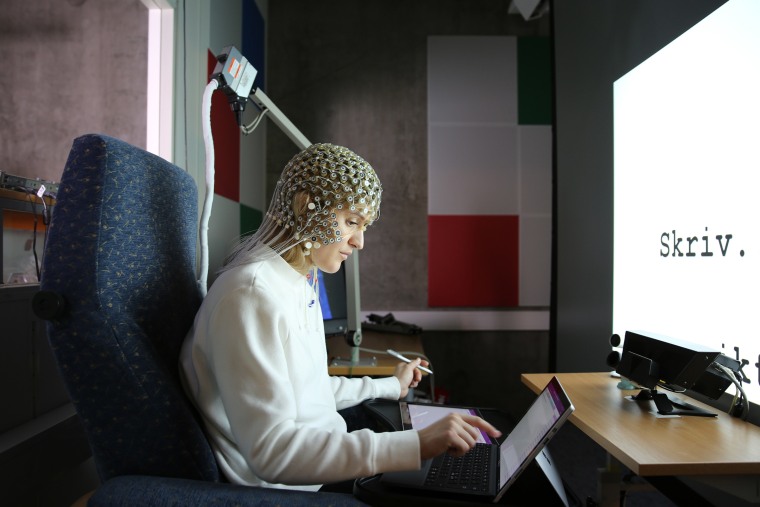
After recording the brain activity of university students, researchers in Norway determined that writing by hand may improve learning and memory.

Study participant wearing a device on head.
A participant in the Norway study. Courtesy NTNU

Typing may be faster than writing by hand, but it’s less stimulating for the brain, according to research published Friday in the journal Frontiers in Psychology.

After recording the brain activity of 36 university students, researchers at the Norwegian University of Science and Technology determined that handwriting might improve learning and memory.

At the start of the experiment, the students were told to either write words in cursive using a digital pen on a touchscreen, or to type the same words using a keyboard. When a word such as “forest” or “hedgehog” appeared on a screen in front of them, they had 25 seconds to write or type it over and over.

Meanwhile, a cap of sensors on their head measured their brain waves. The cap’s 256 electrodes attached to the scalp and recorded the electrical signals of the students’ brains, including where brain cells were active and how parts of the brain communicated with each other.

“Our main finding was that handwriting activates almost the whole brain as compared to typewriting, which hardly activates the brain as such. The brain is not challenged very much when it’s pressing keys on a keyboard as opposed to when it’s forming those letters by hand,” said Audrey van der Meer, the study’s co-author and a neuropsychology professor at NTNU.

In particular, the study found that writing by hand required communication between the brain’s visual, sensory and motor cortices. People who wrote with the digital pen had to visualize letters, then use their fine motor skills to control their movement when writing.

“When you have to form letters by hand, an ‘A’ will look completely different than a ‘B’ and requires a completely different movement pattern,” van der Meer said.

By contrast, when typing, the keys look mostly the same, regardless of the letter. As a result, the study found, typing required less brain activity in the visual and motor cortices.

“Because only small parts of the brain are active during typewriting, there is no need for the brain to communicate between different areas,” van der Meer said.

Van der Meer’s previous research in children and young adults similarly found that people’s brains are more active while writing by hand than while typing. A 2017 study from Indiana University also indicated that writing by hand could link visual and motor skills, which might help kids better recognize letters.

But so far, there’s mixed evidence as to whether taking notes on paper versus a laptop can help people remember and understand information better in the classroom or raise their performance on tests.

It’s also hard to know whether or how the brain activity in the new study might translate into real-life improvements in learning or memory, said Ramesh Balasubramaniam, a neuroscientist at the University of California, Merced, who wasn’t involved in the research.

Source: https://www.nbcnews.com/health/health-news/writing-by-hand-may-increase-brain-connectivity-rcna135880 (DoA: 31/01/2024)

Science Says Sleeping in a Really Dark Room Will Make You Smarter

  Science Says Sleeping in a Really Dark Room Will Make You Smarter The darker the room tonight, the smarter and more alert you’ll be tomorr...

Popular Posts